Frequently Asked Questions about our Firewood Processor Plans

What can be done about the slow operating speed of the chainsaw?

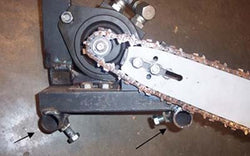
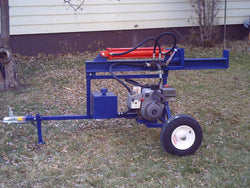
I designed the processor to be constructed as inexpensively as possible. For that reason, the original prototype machine was based off of a 10 hp. engine operating a 16 gpm pump. This runs the chainsaw at approx. 5000 rpm. A larger engine can run a larger pump. A larger pump can handle a larger hydraulic motor for the chainsaw. In essence, it comes down to an input cost issue. To use this plan to make a processor that will cut as fast as a regular chainsaw is possible. However, the increased engine size, and hydraulics can add well over $1,000 to the construction cost. This increase, if you desire to do it, requires no changes to the plans themselves regarding the structure size and welding, only the use of different hydraulic components. In addition to this, a larger sprocket size can be obtained for the chainsaw drive from nearly any chainsaw supplier. The prototype uses the standard size for small saws: 24 inch or smaller bars typically use 7 tooth sprockets. A larger-diameter sprocket will increase chain speed. Look for an 8 tooth
sprocket.

What size hydraulic motor is needed to drive the chain saw?

The prototype I built is powered by a Tyrone MGG20025 hydraulic motor. (This model was discontinued when Tyrone was bought out by Parker.) This motor has a rated output of 5000 rpm with approx. 92 inch lb. of torque per
1,000 rpm using .2.51 gpm per 1,000 rpm. Faster, higher flow, higher torque hydraulic motors will make for faster cutting.

Why does the table appear to twist as the log lifts?

There is a slight twist. This can be easily corrected by placing a trailer jack or drop post under the front corner of the table. Adding steel to the machine will increase its weight and cost. The prototype was kept as simple, light, and inexpensive as possible, so I choose to leave this addition off.

The table seems short for the length of log I would like to use.

The table is designed on the prototype and in the plans to be 8 ft. long and 2 ft. wide. The table could easily be made to whatever size you desire. If larger-sized logs are used, it would be good to make the main rail (splitting rail) out of H beam instead of channel iron.

The cycle time on the splitter seems slow. What can be done about that?

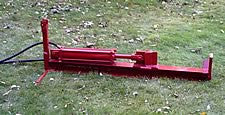
Again, this is a hydraulic component issue. The prototype has a 4-inch cylinder on it with a 24-inch stroke. If a faster cycle time is desired, a smaller cylinder can be used. Smaller cylinders have less volume when extended, requiring less fluid to fill and, thus, fill faster. Larger cylinders, though, have much greater splitting force. I would not recommend a
cylinder smaller than 3 inches (too little splitting force) or shorter than 18 inches (too short firewood lengths). Regarding the Firewood Bundler/Wrapper,

Can a bundle larger than 8 inches be made?

Yes. The plans explain how to determine the ring size and other components to make the size bundle you desire. Any size bundle can be made.

Alabama
Arkansas
California
Colorado
Florida
Idaho
Illinois
Iowa
Kentucky
Maine
Massachusetts
Minnesota
Mississippi
Montana
New Jersey
Ohio
Oregon
Rhode Island
Tennessee
Vermont
Washington
Wisconsin
West Virginia
Alaska
Arizona
Connecticut
Delaware Georgia
Indiana
Kansas
Louisiana
Maryland
Michigan
Missouri
Nebraska
New Hampshire
New York
North Dakota
Oklahoma
Pennsylvania
South Carolina
Utah
Texas
Virginia
Wyoming

And to these countries too:
United Kingdom
Germany
Ireland
Denmark
Canada
Norway
Australia
France
Italy

ATV Log Arch

"Easiest plans I've ever used, Took me about four hours or less."

Busby Sales
Ethridge, TN